

Granite is heavy. Anyone who has carried a countertop piece up a flight of stairs already knows this. A granite weight calculator removes the guesswork. It turns simple measurements into a clear weight number, so you know what you’re dealing with before the truck even arrives.
This tool matters for more than curiosity. It helps contractors quote jobs correctly. It helps homeowners avoid weak cabinets. It helps shipping companies price freight fairly. Below, you’ll find every formula, example, and comparison you need to use this calculator with full confidence.
What Is a Granite Weight Calculator?
A granite weight calculator is a simple tool. You enter length, width, and thickness. It multiplies those numbers together to find volume. Then it multiplies volume by material density to give you total weight in pounds or kilograms.
This is different from a basic stone volume calculator, which stops at volume and skips the weight step entirely. A true granite calculator goes one step further, turning raw dimensions into a number you can actually use for shipping quotes, cabinet planning, and installation crews.
Why Weight Calculation Matters for Granite
Skipping this step causes real problems. Cabinets can buckle under unexpected weight. Moving trucks get booked with the wrong crew size. A quick check with a stone weight calculator prevents all of that before the job starts.
How to Use the Granite Weight Calculator (Step-by-Step)
Using a granite weight calculator takes less than a minute. First, measure your slab’s length and width in inches or feet. Then measure the thickness, usually 2cm or 3cm for most US countertops.
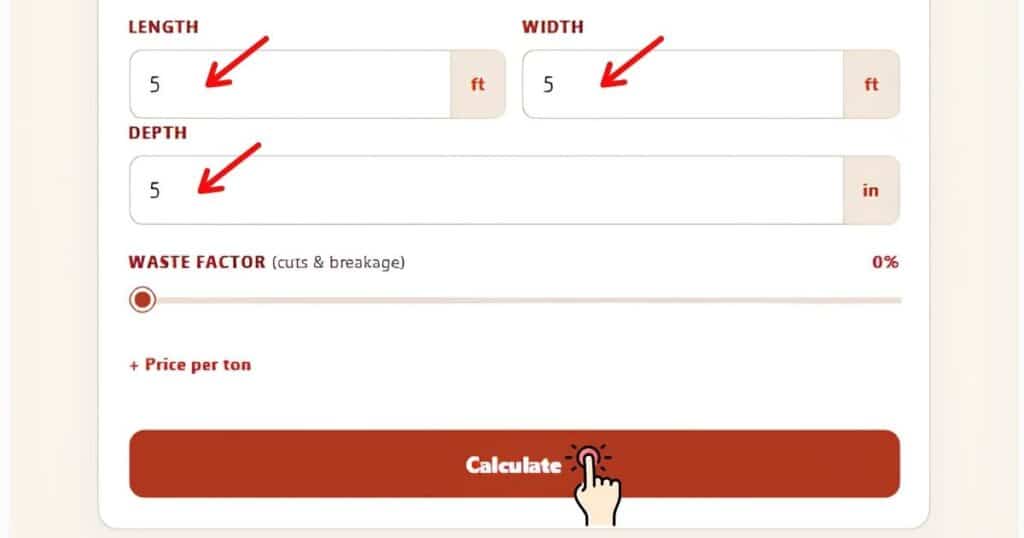
Enter these three numbers into the tool. Pick your preferred unit, either imperial or metric units. Press calculate, and the tool instantly returns total volume and total weight. Most stone calculator tools also let you switch between cubic feet and cubic yards for larger jobs.
Explanation of Each Input Field
Length and width cover the flat surface area of your piece. Thickness adds depth to that flat shape. Together, these three numbers create the full stone volume used in every weight calculation.
Granite Density & Weight Formula Explained
Every granite weight calculator relies on one core formula: volume multiplied by material density equals weight. For a rectangular slab, volume equals length times width times height, following the standard volume formula used across construction math.
weight = volume×granite density
Granite density is not one fixed number. It shifts slightly depending on mineral content. Stones with more quartz and feldspar tend to weigh a bit more than lighter, mica-rich varieties.
Average Density of Granite (kg/m³, lbs/ft³)
Granite density typically falls between 1.556 oz per cubic inch and 168.05 lbs per cubic feet. Most fabricators round this to 170 lbs/ft³ for quick, safe estimates on the job site.
Granite Weight Calculation Example
Here’s a real worked example, just like a fabricator would run on-site. Take a slab measuring 50 inches long, 20 inches wide, and 2 inches thick, a common size for a kitchen island top.
First, find the volume. Length times width times height equals 2,000 cubic inches, which converts to 1.16 cubic feet. Next, multiply that volume by granite density: 1.16 cubic feet times 168.05 lbs per cubic foot equals 194.5 pounds.
| Step | Calculation | Result |
|---|---|---|
| Volume | 50in × 20in × 2in | 2,000 cu in = 1.16 cu ft |
| Weight | 1.16 cu ft × 168.05 lb/cu ft | 194.5 lb |
| Cost | 194.5 lb × $15/lb | $2,917.50 |
That final cost row matters just as much as the weight itself. Once you know the weight, a stone cost calculator step multiplies it by price per pound, giving you a full, ready-to-quote number.
Weight of Granite by Slab Size & Thickness
Thickness changes the final weight more than most people expect. A 2cm slab weighs noticeably less than a 3cm slab covering the same surface area, even though the difference sounds small on paper.
| Slab Thickness | Approx. Weight per Sq. Ft. |
|---|---|
| 2cm (¾ inch) | 10–13 lb |
| 3cm (1¼ inch) | 18–20 lb |
| Full raw slab | 1,000–1,800 lb |
Countertop vs Full Slab Weight Comparison
A finished countertop piece is much lighter than the raw granite slab weight it came from. Quarries ship full slabs weighing over 1,000 pounds, but fabrication cuts that number down considerably before installation.
Circular & Rectangular Granite Pieces – Weight Difference
Shape changes the math. Rectangular pieces, like most countertops, use the standard formula: area equals length times width, and volume equals length times width times height.
area = length×width , volume = length×width×height
Round pieces, like tabletops or sink cutouts, use a different formula entirely. Area equals pi times radius squared, and volume equals pi times radius squared times thickness, following standard cylinder geometry.
area = π×radius2 , volume = π×radius2×thickness
A round table with a 2-foot radius covers roughly 12.5 square feet. That’s noticeably less surface area than a rectangle with similar outer dimensions, which means a lighter final weight on your rock weight calculator result.
Granite vs Other Stones (Marble, Quartz, Limestone) – Density Comparison
Granite sits in the mid-to-heavy range among natural and engineered stones. A marble calculator often returns a very close number, since marble density sits near granite’s own range.
| Stone Type | Density (kg/m³) |
|---|---|
| Granite | 2,630–2,750 |
| Marble | 2,560–2,750 |
| Quartzite | 2,600–2,700 |
| Limestone | 2,300–2,600 |
| Sandstone | 2,200–2,500 |
| Basalt | 2,800–3,000 |
| Slate | 2,700–2,800 |
A quartz weight calculator for engineered quartz often returns a slightly lower number, since manufactured quartz contains resin binders that weigh less than solid natural stone.
Who Should Use This Calculator?
Fabricators run a granite calculator daily to plan shipping logistics before a job even starts. Kitchen designers use it to confirm cabinet load limits during the planning phase, well before installation day.
Homeowners shopping online benefit too, since many retailers quote shipping by weight, not square footage. A construction stone calculator also helps general contractors budgeting larger commercial projects with multiple stone types involved.
Cost Estimation Based on Granite Weight
Shipping companies often price by the pound, not by the square foot. That’s exactly where a stone cost calculator step becomes useful, turning a simple weight figure into a real dollar quote.
Using the earlier example, 194.5 pounds at $15 per pound comes to $2,917.50 total. Heavier slabs always cost more to ship, even when their surface area looks similar to a thinner, lighter piece.
Accuracy, Limitations & Disclaimer
No stone density calculator accounts for every real-world detail. Sealants, edge profiles, and moisture content can all shift the final number slightly higher or lower than the raw estimate.
Treat every result as a strong planning figure, not a certified engineering number. For load-bearing decisions involving cabinets or flooring, a licensed contractor should always verify the installed weight on-site before work begins.
Final Thoughts
A granite weight calculator turns a stressful guessing game into a quick, confident answer. Whether you’re a fabricator, a homeowner, or a moving company, knowing the exact weight of your stone protects your cabinets, your budget, and your back.
Getting this number right, before ordering, shipping, or installing, saves everyone involved from costly surprises down the line. Whether you’re working with granite, marble, or another natural stone, the same simple formula applies every time: measure, multiply, and calculate with confidence.
Frequently Asked Questions
A standard 3cm slab weighs roughly 18 to 20 pounds per square foot, depending on the specific stone’s density.
Yes. Natural granite typically outweighs engineered quartz, since quartz contains lighter resin material mixed into its structure.
A 3cm countertop section weighs between 18 and 20 pounds per square foot on average, based on standard density figures.
A 3cm countertop section weighs between 18 and 20 pounds per square foot on average, based on standard density figures.
Standard kitchen cabinets generally support 200 to 400 pounds when properly reinforced. A professional check is always worth the peace of mind.

I’m Hannah Levin, a content writer with over 5 years of experience creating SEO-friendly content about digital marketing, technology, business, and online growth. I enjoy turning complex topics into simple, practical guides that help readers find accurate answers and make informed decisions.