
Ordering a stone calculator worth of material without a plan almost always ends the same way — too much stone sitting in the driveway, or a rushed second trip back to the supplier. Whether you’re using a stone estimator for a small garden bed or working out tonnage for a full driveway, guessing at depth and density wastes both money and time.
Stone Calculator
Get tons, cubic yards, and cost — from dimensions, a known area, or a known volume.
Results: Stone Needed
A reliable stone calculator solves this by turning simple measurements into an exact cubic yards figure and a ready-to-order ton count before you spend a dollar. This guide breaks down the formula step-by-step, covers crushed stone, pea gravel, and specialty grades like 57 stone, and walks through real project examples so every number you calculate matches what actually shows up on the delivery truck.
How to Use Our Stone Calculator
Using a stone calculator takes three inputs: length, width, and depth of your project area. Enter those measurements, pick your stone type, and the tool converts everything into cubic yards and tons automatically. There’s no need to hunt down density charts or guess how crushed stone compares to pea gravel.
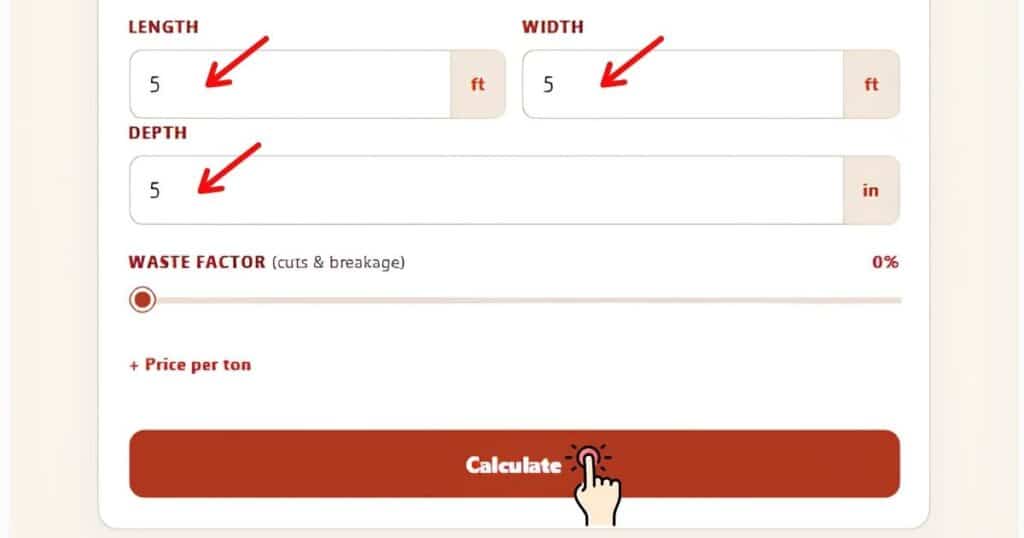
Behind the scenes, the calculator pairs volume with price per ton, so you learn not just how much stone to order but roughly what it costs. That’s the difference between a rough estimate and a number you can actually take to a supplier.
How Much Stone Do You Need? Step-by-Step Guide
Start by measuring length and width in feet, then multiply them for square footage. Next, decide your depth — walkways usually need 2 to 3 inches, driveways need 4 to 6. Multiply square footage by depth in feet, and you’ve calculated cubic feet, the raw number every stone estimator builds on.
Here’s a real example. A homeowner in Ohio wanted a stone patio measuring 15 feet by 12 feet, at 3 inches deep. That’s 180 square feet, multiplied by 0.25 feet of depth, giving 45 cubic feet. Divide by 27 to convert cubic feet to cubic yards, and you land at exactly 1.67 cubic yards — a number her supplier confirmed almost to the decimal.
This same process works whether you’re planning stone for a patio, a walkway, or a drainage bed. Only the depth changes between applications; the underlying volume formula stays identical across every project type you’ll encounter.
How to Figure Stone Tonnage Manually
Volume alone won’t get a delivery scheduled, since stone is sold by weight. Multiply cubic yardage by the material’s weight per cubic yard, usually 1.4 to 1.7 tons for standard aggregate. In the patio example above, 1.67 cubic yards at 1.5 tons per yard works out to about 2.5 tons — enough for one small delivery truck run.
How Much Crushed Stone Do You Need?
Crushed stone calculations follow the same volume-to-tonnage formula, but density shifts depending on the exact size and shape you buy. Angular crushed stone compacts tighter than rounded gravel, meaning slightly more weight fits into the same cubic yard once you estimate crushed stone for a project.
A landscaper in North Carolina recently reworked a backyard border bed, 30 feet long, 2 feet wide, at 4 inches deep. That comes out to 60 square feet, 20 cubic feet, or 0.74 cubic yards. Using 1.5 tons per cubic yard for crushed stone, the order came to just over 1.1 tons — small enough to fit in the bed of a standard pickup truck, no delivery fee required.
Crushed Rock vs Regular Stone: Quantity Differences
Crushed rock’s jagged edges lock together under compaction, reducing the air gaps you’d see with smoother, rounded stone. That tighter packing means a cubic yard of crushed rock often weighs more than the same volume of river rock. Always confirm density with your supplier before finalizing an order.
Gravel Driveway Calculator: Stone for Driveways
Driveways demand more depth than almost any other common project, typically 4 to 6 inches across two or three compacted layers. A gravel driveway calculator factors this layered approach in, since a coarser base layer often sits beneath a finer top layer for drainage and stability.
Take a second real example: a 12-foot by 60-foot driveway in rural Texas, resurfaced at 5 inches deep. That’s 720 square feet, or 11.1 cubic yards once depth is factored in. At 1.5 tons per cubic yard, the homeowner ordered almost exactly 16.7 tons — split across two deliveries because of truck weight limits.
Gravel Driveway Cost Estimate Per Ton
Price per ton for gravel typically runs $15 to $50 depending on region and stone type, before delivery fees. The Texas driveway above, at roughly 17 tons, landed near $450 in material costs alone. Getting quotes from two or three local suppliers protects against regional price gouging.
Pea Gravel Estimator: How Much Pea Gravel Do You Need?
Pea gravel sits lighter than crushed stone, typically 1.3 to 1.5 tons per cubic yard, because its small, rounded pieces settle more loosely. A pea gravel calculator adjusts for this automatically, so you don’t accidentally order using a crushed-stone density figure and end up short.
How Many Bags of Pea Gravel Do You Need?
For small beds, bagged pea gravel makes more sense than bulk delivery. A standard half-cubic-foot bag covers roughly 6 square feet at 1 inch deep. A 50-square-foot flower bed at 2 inches deep needs about 8.3 cubic feet, or roughly 17 bags.
How Much Does 1 Ton of Gravel Cover?
One ton of gravel covers roughly 100 square feet at 2 inches deep, though coverage shifts with stone size and depth. Thinner applications stretch a ton further, while a deeper 6-inch driveway base might only cover 35 to 40 square feet per ton — a distinction many competing guides skip entirely.
Stone Size & Type Variants: 57 Stone, 2B Stone, 3/4 Stone, Stone Dust
Stone naming conventions confuse plenty of first-time buyers, since numbers like 57 stone and 2B stone refer to size grading, not quality. Drainage stone and base-layer stone behave very differently once compacted, so matching the right grade to the right job matters more than most guides admit.
Stone dust, by contrast, compacts into a nearly solid base layer and typically sits beneath pavers rather than serving as a standalone surface. Larger rip rap needs its own density figures entirely, running heavier per cubic yard than most landscaping stone.
2B stone, slightly larger than 57 stone at around 1 to 2 inches, works well for driveway sub-bases where drainage matters more than a smooth finish. 3/4-inch stone sits between the two, popular for walkways where foot traffic needs a stable, walkable surface without the sharper edges of larger aggregate.
How Much 57 Stone Do You Need?
57 stone weighs roughly 1.4 tons per cubic yard, similar to standard crushed stone, so the same volume formula applies directly. A drainage trench 20 feet long, 1 foot wide, and 1 foot deep needs about 0.74 cubic yards, or just over 1 ton.
How Much Chippings Do You Need?
Stone chippings, often used for decorative pathways, typically need only 1 to 2 inches of depth. A 100-square-foot path at 1.5 inches deep requires about 0.46 cubic yards, translating to roughly 0.7 tons — a manageable order for a small bulk purchase.
Stone Calculator Formula (Square Footage & Volume)
Every stone calculator ultimately reduces to one formula: length times width times depth, divided by 27, equals cubic yards. From there, multiply cubic yards by density to reach tonnage. This two-step process works identically whether you’re calculating landscape rock, river rock, or fine stone dust.
Suppliers rarely quote in cubic feet, so mastering this conversion saves you from miscommunication at order time. Once you understand it, you can estimate landscaping materials for nearly any project without leaning on a calculator at all, though the tool still saves time.
Square footage alone isn’t enough for irregular yards, either. Break an L-shaped patio into two rectangles, calculate each section’s volume separately, then add the totals together before converting to tons. This same approach handles curved beds and oddly shaped drainage runs just as reliably.
Conclusion
A dependable stone calculator turns rough guesswork into a precise, deliverable-ready order every time. Match your material’s density to the right project type, measure carefully, and always build in a small buffer for compaction. That combination separates a smooth delivery from a costly, repeated trip to the supplier.
Frequently Asked Questions (FAQ)
Most suppliers price bulk stone by the ton, though some decorative varieties are quoted by the cubic yard instead.
Reliable tools add a 5–10% buffer, since compacted stone settles below its poured depth.
Gravel forms naturally through erosion, while crushed stone is mechanically broken down, giving it sharper, more angular edges.
Most driveways need 4 to 6 inches across compacted base layers for adequate vehicle support
Yes — break the area into rectangles or triangles, calculate each separately, then add the totals together.