
Planning a driveway or parking lot project? An asphalt calculator takes the guesswork out of ordering material. You punch in your dimensions, and it tells you exactly how much blacktop you need — no more overordering or running short mid-job. Whether you’re a homeowner tackling a small driveway or a contractor bidding a commercial lot, getting your numbers right saves both time and money.
Asphalt Calculator
Calculate Asphalt Area, Volume, Weight and Tons Required.
0
Area
0
Volume
0
Weight (lbs)
0
Asphalt Tons
0
Truckloads
Enter a price above
Estimated Material Cost
Formula
Area = Length × Width
Volume = Area × Thickness
Weight = Volume × 145 lb/ft³ × (1 + Waste Factor)
Tons = Weight ÷ 2000
Frequently Asked Questions
How much does asphalt weigh?
Standard compacted asphalt weighs approximately 145 pounds per cubic foot (about 2,320 kg per cubic meter). Hot mix asphalt can run slightly heavier at 150 lb/ft³, while cold mix is typically lighter around 140 lb/ft³.
How is asphalt tonnage calculated?
The calculator multiplies your paved area by the compacted thickness to get volume, then multiplies that volume by the asphalt density to get weight. Weight is then converted into tons (or tonnes if using metric units).
Why add a waste factor?
A waste factor (usually 5–10%) accounts for material lost during transport, spreading and compaction, so you order enough asphalt to finish the job without running short.
How many tons of asphalt do I need per truckload?
A standard dump truck typically carries around 10 tons (about 9 tonnes) of asphalt per load. Divide your total tonnage by 10 to estimate the number of truckloads needed.
What thickness should I use for a driveway vs a road?
Residential driveways are usually paved at 2–3 inches compacted thickness, while roads and heavier-traffic areas often require 3–5 inches or more, depending on local specifications.
This guide walks you through how the math works, what affects your asphalt tonnage calculator results, and what a realistic budget looks like for 2026 pricing across the United States.
How Does an Asphalt Calculator Work?
At its core, figuring blacktop tonnage comes down to volume and density. You measure your area, multiply by thickness, and convert that volume into weight using asphalt density. Most hot-mix asphalt weighs around 145 pounds per cubic foot, though this varies slightly by mix design and aggregate type.
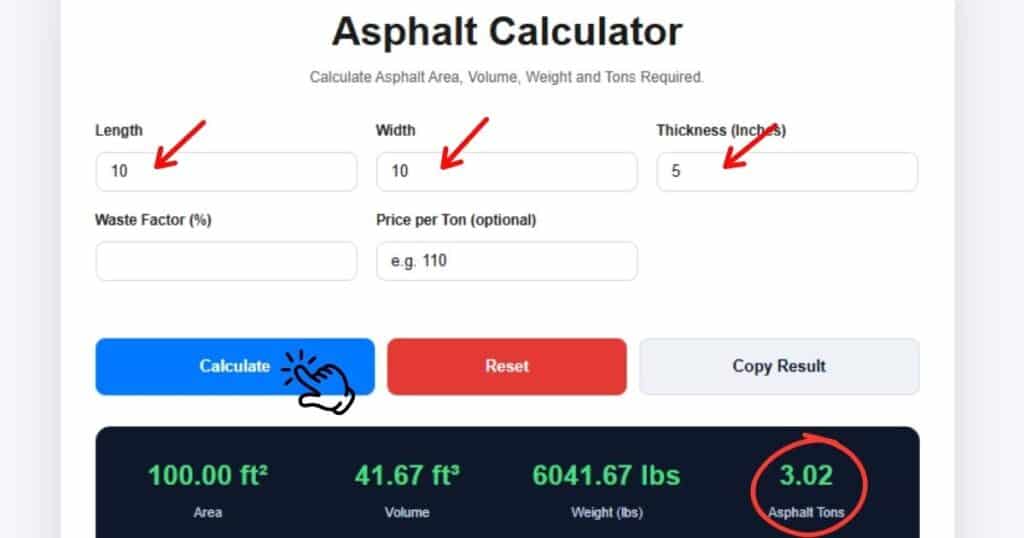
Here’s the basic formula contractors use every day:
- Length (ft) × Width (ft) = Area (sq ft)
- Area × Thickness (ft) = Volume (cubic ft)
- Volume × 145 lbs ÷ 2,000 = Tons of asphalt needed
If you’re wondering how much asphalt will I need for an irregular shape, break the area into rectangles and triangles, calculate each separately, then add them together. This trick works for L-shaped driveways, curved edges, and multi-section lots alike.
Figuring Asphalt Tonnage: A Step-by-Step Example
Let’s say you’re paving a driveway that’s 20 feet long and 20 feet wide, at a standard 2-inch thickness. Here’s how to figure blacktop tonnage for that space:
- Area: 20 × 20 = 400 sq ft
- Thickness: 2 inches = 0.167 ft
- Volume: 400 × 0.167 = 66.8 cubic ft
- Weight: 66.8 × 145 = 9,686 lbs
- Tons needed: 9,686 ÷ 2,000 = about 4.8 tons
That’s roughly what you’d order for a standard two-car driveway. Contractors typically round up 5–10% to cover compaction loss and uneven subgrade, so plan on closer to 5 tons to stay safe.
How Much Does a Ton of Asphalt Cover?
This is one of the most common questions people search when using a blacktop calculator. The coverage depends entirely on thickness:
| Thickness | Coverage per Ton (approx.) |
|---|---|
| 1 inch | 80 sq ft |
| 1.5 inches | 65 sq ft |
| 2 inches | 55 sq ft |
| 3 inches | 40 sq ft |
So if someone asks how much does a ton of asphalt cover, the honest answer is “it depends on how thick you’re laying it.” A thinner overlay stretches material further, but it also wears out faster under vehicle traffic and weather cycles.
Asphalt Driveway Cost Calculator: What to Budget
Beyond tonnage, most homeowners really want to know the bottom line. An asphalt driveway cost calculator typically factors in material, labor, base prep, and equipment. As of 2026, expect to pay somewhere between $3 and $7 per square foot installed, depending on your region, base condition, and local material costs.
For that same 400-square-foot driveway example above, that puts total cost in the $1,200 to $2,800 range. Prices run higher in areas with tighter contractor availability or where you need significant grading and drainage work before paving even starts.
Is a 20×20 Asphalt Driveway Cost Calculator Estimate Realistic?
For a 20×20 driveway (400 sq ft), you’re looking at roughly $1,200 to $2,800 installed at standard 2-inch depth, assuming a reasonably stable subgrade. Older driveways needing full tear-out and base replacement will land at the higher end — sometimes beyond it — since demolition and hauling add real cost.
What Is Asphalt and What Is It Made Of?
Asphalt is a composite material built from aggregate (crushed stone, sand, and gravel) bound together with bitumen, a sticky petroleum-based binder. This combination gives asphalt its flexibility and durability — it can handle freeze-thaw cycles and heavy loads without cracking the way rigid materials sometimes do.
The hot-mix asphalt used in most driveways and roads is produced by heating aggregate and bitumen together, then compacting the mixture while it’s still hot. This process is why timing matters so much during installation; asphalt that cools too fast won’t compact properly.
How to Determine Your Asphalt Requirement
Getting an accurate asphalt estimator result starts with precise measurements. Walk your site and note:
- Total square footage of the paving area, including any curves or irregular sections
- Required thickness — 2 inches for residential driveways, 3–4 inches for areas handling heavier vehicles
- Base condition — a crumbling or uneven base may need extra prep material before you even lay asphalt
Once you have these numbers, run them through the tonnage formula above, or use a dedicated asphalt ton calculator tool to skip the manual math entirely.
Notes to Consider When Applying Asphalt
A few practical details make a real difference in how long your pavement lasts:
- Temperature matters. Asphalt should be laid when ground temps are above 50°F for proper compaction.
- Drainage first. Standing water is asphalt’s biggest enemy — grade your site to shed water away from structures.
- Compaction is everything. Under-compacted asphalt fails early, cracking and rutting far sooner than properly rolled surfaces.
- Sealcoating helps. Applying sealcoat 6–12 months after installation extends surface life significantly.
Advantages of Using Asphalt
Compared to concrete, asphalt offers a few clear wins for most residential and light-commercial projects:
- Faster installation — driveways are often usable within 24–48 hours
- Lower upfront cost per square foot in most markets
- Easier repairs — cracks and potholes patch more simply than concrete
- Flexibility — asphalt handles ground movement and freeze-thaw cycles better than rigid concrete slabs
How Much Crushed Asphalt Do I Need for a Base Layer?
If you’re using recycled or crushed asphalt as a base layer beneath new pavement, the same tonnage formula applies — just adjust your density figure slightly, since crushed material compacts differently than fresh hot-mix. A 4-inch crushed asphalt base under a driveway typically needs roughly double the tonnage of a 2-inch topcoat layer for the same square footage.
Multiply your area (length × width) by thickness in feet to get volume, then multiply by 145 lbs and divide by 2,000 to get tons.
Expect roughly $1,200 to $2,800 installed, depending on base condition and regional labor rates.
About 55 square feet at standard 2-inch depth.
At 2 inches thick, that’s roughly 90 tons of material, putting installed cost around $6,000 to $14,000 depending on location.
Yes, for standard passenger vehicle driveways. Heavier vehicles or commercial use typically call for 3–4 inches.